
 |
|||||||||||||
|
|||||||||||||
|
The
Pentagram By Mike Nichols
|
|
|||||||||||
| The pentagram, or five-pointed star, may be the most misunderstood religious symbol around these days. Being the most common symbol of Neo-Pagan Witchcraft, it has nevertheless been denigrated by movie and publishing industries which seem 'hell-bent' on connecting it with Satanism and other malevolent practices. However, like the Roman Cross or Crucifix, it is only when the symbol is INVERTED that it alludes to negativity. And even then, there are exceptions, as we shall see. | 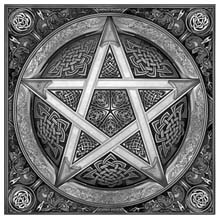
|
||||||||||||
| In its usual upright position (one point uppermost), the pentagram is an ancient symbol of protection from evil. Also called 'the endless knot' (in its interlaced form), the pentagram was often displayed on doors, windows, and hearths of houses throughout pre-Christian Europe. It can be traced back to Egyptian and Sumerian cultures, and has even been found on Native American medicine tools. Sometimes mistakenly confused with the Star of David, or hexagram, the pentagram is sometimes called the Star of Solomon, especially by ceremonial magicians. To many, the lower four points represent the classical elements of earth, air, fire, and water, while the fifth point, surmounting the others, represents spirit, the fifth element or quintessence. Thus, the pentagram symbolizes the four elements of the material world connected with, but ruled by, the spirit. When the pentagram is placed within a circle (symbol of unity and wholeness), it stresses our connection with the universe as a whole. | |||||||||||||
| Another
interpretation is that there is not one point upward -- but three!
In numerology, three is the number of harmony, best expressed in
the classical formula: thesis, antithesis, and synthesis. In other
words, it is the middle point that harmonizes the opposing outer
points. The Celtic love of triads has its roots in this model. The
upper three points are thus placed above the lower two points, which
represents dualistic opposites that cannot be integrated or harmonized
(seeing everything in black and white). Yet another interpretation of the upright pentagram is that it symbolizes the most common view of deity in Witchcraft. The upper three points represent the Goddess in her threefold aspect of Maiden, Mother, and Crone. The lower two points represent her consort God, in his twin aspects of God of Light and God of  Darkness.
However, in all these interpretations, it is important to remember
that all the points are connected, each an aspect. Darkness.
However, in all these interpretations, it is important to remember
that all the points are connected, each an aspect.But when the pentagram is inverted, so is its meaning. Thus, an inverted pentagram may represent the physical world (four material elements) in domination of the world of spirit (the fifth element). (This may be why Satanists and other 'demonistic' groups use this symbol.) With two points uppermost, it may also express a Neo-Platonic dualism (the old 'war in heaven', good vs. evil theme) -- as opposed to the Pagan monistic view of reality ('the Force') seen in the single point upward. The most common exception to this rule is that some traditions of Witchcraft (chiefly British) employ the inverted pentagram as a POSITIVE symbol of advanced degree. In this case, the two points uppermost represent the horns of light, symbol of 'the Horned God', consort to the Great Goddess (like the Greek god Pan). The word 'pentacle', sometimes mistakenly substituted for pentagram, really refers to a shallow dish (usually inscribed with a pentagram) and used as an altar tool by modern Witches, serving a purpose similar to the 'patten' at a Roman Catholic Mass. Common variations of this tool include a dish of earth, a disk of copper, a dish of silver, or a disk of wax. of the other, all part of the same whole. |
|||||||||||||
 The suit of pentacles (or 'coins') in the Tarot deck, the Stone
of Fal (coronation stone of kings) in ancient Ireland, the sangreal
of the Holy Grail processions, and the 'Universal Man' of Leonardo
da Vinci, are all related to the pentagram, stressing its ties
to the earth and nature, making it a symbol par excellence of
an earth or nature religion. The five points also represent the
five physical senses and allude to approaching the spiritual realm
THROUGH the sensual -- in fact, the meaning
of the Ace of Pentacles in Tarot. In numerology, 5 is the number
of sexuality, combining the feminine 2 with the masculine 3. Thus,
the pentagram also represents the opposite of asceticism.
The suit of pentacles (or 'coins') in the Tarot deck, the Stone
of Fal (coronation stone of kings) in ancient Ireland, the sangreal
of the Holy Grail processions, and the 'Universal Man' of Leonardo
da Vinci, are all related to the pentagram, stressing its ties
to the earth and nature, making it a symbol par excellence of
an earth or nature religion. The five points also represent the
five physical senses and allude to approaching the spiritual realm
THROUGH the sensual -- in fact, the meaning
of the Ace of Pentacles in Tarot. In numerology, 5 is the number
of sexuality, combining the feminine 2 with the masculine 3. Thus,
the pentagram also represents the opposite of asceticism. |
|||||||||||||
This document can be re-published only as long as no information is lost or changed, credit is given to the author, and it is provided or used without cost to others. Other uses of this document must be approved in writing by Mike Nichols. Revised: Tuesday, March 19, 2002 |
|||||||||||||
|
|||||||||||||
|
This site and all content are the sole and
exclusive property of Lakefront Associates & J. Nasty. |
|||||||||||||